Two Strangers (Carry A Cake Acrooss New York)
An enchanting new musical centered around a meet-cute between two unlikely strangers in NYC..
“Two Strangers (Carry A Cake Across New York)”
Reviewed by Cynthia Allen
(11/19/2025)
In Two Strangers (Carry a Cake Across New York) an airport pick-up, adventures delivering a cake, unintended detours around New York City, and a potential "crashing a wedding" lead to an atypical friendship with romantic overtones. The musical is about two twenty-something people, Dougal and Robin, who discover that friendship can unfold over two days in meaningful, fun, and unique ways.
The story centers around Robin's sister (Melissa, an unseen presence), who is about to marry Dougal's father (Mark, another unseen actor) the following day. Robin (Christiani Pitts) is assigned to pick Dougal (Sam Tutty) up at JFK. Because this is Dougal's first trip to New York City, Robin is quickly put into the role of babysitter-caretaker, and as the evening unfolds, even tour guide. Dougal wants to experience "all" of the Big Apple's highpoints before he goes to his father's wedding. Like a wide-eyed puppy eager to experience the City's adventures, Dougal's enthusiasm gradually wears down Robin's misanthropic nature over the course of the night. However, it is revealed that Dougal's father is unaware that a son he abandoned before he was born is attending the wedding. Melissa sent Dougal a wedding invitation, and only Melissa, Robin, and Dougal are aware that Dougal was invited, not Mark.
Perennially cheerful Dougal and an anxious Robin are mismatched in moods and sensibility as an optimistic Brit and a cynical Brooklynite. Dougal (played by a charismatic Sam Tutty, who originated the role in London and won an Olivier for his performance), and Robin (played with nervous pessimism by Christiani Pitts, who repeats her role from its transfer to the American Repertory Theater in Cambridge, Massachusetts), bring to their performances a synergistic chemistry that is infectious. Jim Barne's and Kit Buchan's captivating book and engaging musical score make the duo's serendipitous experiences throughout their NYC travels charismatic and alluring. Tim Jackson's direction and choreography are noteworthy and complement Soutra Gilmour's set (Gilmour is also the costume designer). Gilmour's scenic ingenuity even acts as another character. With two large stacks of suitcases on an occasionally revolving carousel as the only set throughout the musical, the suitcases function as stage props that the actors can use to their advantage in whatever location they find themselves, as well as providing hidden spaces for other props. Gilmour's artistic je ne sais quoi provides Jackson with an imaginative means of approaching both his choreography and direction. Her set allows Jackson to cleverly use the abundance of stacked suitcases for the couple to navigate in innovative scenic ways. In addition, as the delightful music plays, Jack Knowles's attentive lighting scheme unusually highlights the suitcases. At the same time, both the score and the set pieces create a magical, whimsical quality.
Two Strangers (Carry a Cake Across New York) is not about star-crossed lovers, or even presenting itself as a traditional rom-com. The musical portrays two unlikely people who discover that friendship can unfold over two days in meaningful, fun, and unique ways, which doesn't necessarily end with the couple having their cake and eating it too.
Longacre Theater
Opening Night: November 20, 2025

WEER
Depicts a toxic romance in a bold, adventurous way that only Natalie Palamides could.
“WEER”
Reviewed by Cynthia Allen
(11/05/2025)
Weer's program cover focuses the audience's attention on a deer caught in a car's headlights, with the date "1999 23:24," prominently etched into the automobile's dashboard. Cherry Lane Theatre's U.S. extraordinary solo show of Weer is performed and directed by Natalie Palamides. She cleverly decided to use a faire trébucher approach, where one has to trip over an image to get to the story -- in this case, a photo of the car's dashboard and date. Both the play's title, Weer, and the program cover by design, serve as first encounters to dual relationships and double meanings of what Weer is about.
The story begins with a couple's fight near midnight on New Year's Eve 1999. Their bickering escalates and culminates in a tragic accident involving their car on the way home from a party. Then, the evolution of their three-year relationship that devolves into an unhealthy relationship characterized by toxic romance, abuse, and betrayal is portrayed through flashbacks. Throughout the story, two points of view are portrayed in a unique way as to what occurred before that tragic New Year's Eve evening. The word "we're," rather than "I" or "me" or "you," is used when each character talks. In addition, the word "deer" is intentionally mispronounced and often voiced as "weer."
What makes Weer both unusual and unforgettable is Natalie Palamides' gender-bending performance, or actually dual performances. She plays two sides of a heterosexual couple -- plaid-shirted Mark with a stubble beard on her left and pink-bloused Christina with a 1990s frou-frou hairstyle on her right. Palamides portrays both roles at the same time, with her outfits and wigs divided asymmetrically down the middle (kudos to Ashley Dudek for her costumes and make-up). Palamides creates (and directs) a daring solo show where she asks the audience to see the two halves' -- both sides' opinions, negative or positive -- from either Mark’s or Christina’s point of view.
Weer is a unique entrée into the world of alt-clown and comedian phenom Natalie Palamides. Her performance is a tour de force bit of acting; for 90 minutes she switches from left to right, (from Mark to Christina), or right to left (Christina to Mark), depending on which character is talking. Back and forth between portraying comedy and adversity is integral to clowning, the art form that Palamides holds dear. Weer is Palamides' take on an absurd 1990s GenX romcom, albeit with nods to the 1993 TV family sitcom "Boy Meets World" and Britney Spears music videos.
The 1960s song, "Last Kiss," by Wayne Cochran and popularized in the 1990s by Pearl Jam, inspired her in writing Weer, with its juxtaposition of love and death. In a NY Times interview, Palamides shared that she likes the dichotomy of a story being both comic and tragic at the same time. The ending lyrics of “Last Kiss” were apt:
"....I lifted her head, she looked at me and said
‘Hold me darling, just a little while’
I held her close, I kissed her, our last kiss."
Palamides' aunt played "Last Kiss" over and over again when Palamides was a child. The "Last Kiss" lyrics with the images of a violent car crash, a man holding his love as she bled out, and her dying last words haunted her for decades. So, a melodramatic car crash at the outset of her play conjured up the ideal beginning of her comic-tragic story. She also integrated the actual music into her play, with Mark turning up the volume louder and louder of "Last Kiss” to an unexpected outcome. The song’s story created the play's framework as a comedic tragedy, blending high-energy improv burlesque with grief to depict a relationship's demise.
Palamides both plays the audience and plays with the audience. Her classic clowning and improvisation expertise draw out hysterical scenarios that only an experienced mime could accomplish, particularly a sex scene. Gabriel Evanshohn's scenic design and Lucas A. Degirolamo's props are both used to create bedlam and hilarity. Palamides draws upon them to interact with the audience and break the fourth wall in unexpected comedic ways.
Weer was first performed at the Edinburgh Festival Fringe in August of 2024 and then transferred to London's West End Soho Theatre in late fall of 2024. The show made its Off-Broadway New York debut in September 2025 at the newly revamped Cherry Lane Theatre, a fitting showcase for the historic venue's reopening after its acquisition by A24 in 2023, as Weer became a must-see experience. Who would have thought a kiss with death would become a death-defining experience?
A-24 and Cherry Lane Theatre
38 Commerce Street, New York City, NY
Opened: September 28, 2025
Closing Date: December 21, 2025

Julio Torres' Color Theories
Part Pee-Herman and part Salvador Dalí, absurdist comedian and surreal artist Julio Torres explains his quirky point of view about the aesthetic and emotional significance of different colors in his remarkable stand-up comedy show, "Color Theories."
“COLOR THEORIES”
Reviewed by Cynthia Allen
(10/08/2025)
Julio Torres is an exceptional performer who is both an absurdist comedian and a unique sketch writer. Torres is part Pee-Herman and part Salvador Dalí in his endeavor to create an original approach to storytelling. He mind-bends his show, "Color Theories," into whimsical musings on how colors behave and how they can influence a person's behavior. No director is credited, but Jack Serio is acknowledged as the show's “artistic consultant,” who worked with Torres to prop up Torres's unique vision.
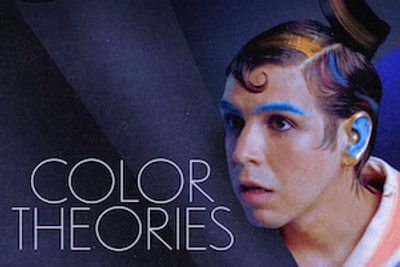
The program's cover art highlights Torres's unconventional comedic narrative ideas. The program art has Torres's portrait and play title set askew, as he gazes into the ether with a look of awe. Torres's face is painted with blue eyebrows and blue ears, with hints of orange in his hair and his right earlobe. Reds, purples, and other colors peek through other parts of his head (Sean Bennett designed the hair). Whimsical ribbons of color pour out over his head. Torres' smock (Muriel Parra designed the costumes) is a many-colored dream coat. Torres's eyes are fixated on what he might imagine as an alternate reality, where color takes on new dimensions. Torres's show is all about awe, and Torres creates a postmodern clown, albeit a school art teacher, who is quirky, mesmerizing, and full of amazement about his conception of a wonder-filled world.
Emmy-nominated, Peabody Award and WGA-winning Salvadorian writer, artist, and performer Julio Torres is a multi-hyphenate and difficult to categorize. In "Color Theories," Torres imagines his stage (Tommaso Ortino is the set designer) as a rehearsal space for a fictional version of himself as a teacher to try out a lecture series he envisions performing to elementary schools as the newly appointed Director of Education for the City of New York. Whereas conceptually, Torres walks the line as a surrealist, as an actor, Torres performs realistically. He comes across as a down-to-earth, caring high school art teacher who truly wants his students to learn about color theories.
The center of the stage is presented as a huge pop-up storybook. Torres makes props (and "stagehands") come to life. Surrounding the pop-up book are set pieces reminiscent of a carnival fun house. Torres pops up and out of the storybook to become the art instructor who will take the audience on his personal journey of color meanings. At the outset of the play, the "extras" (the two silent anthropomorphized stagehands, with Nick Meyers functioning as a "Music Box" and Drew Rollins likened to a pool of "Spilled Wine") move props hither and yon as instructed by Torres, but they fade away during the play. In addition, there is a quasi-prop or set piece, the clock tower with a door that periodically opens. The "Timekeeper," Bibo the Robot, in the clock tower, makes appearances through the door to make sure Torres does not dwell too long on one color (Bibo is designed by Monkey Boy Productions, operated by Ian Edlund, and voiced by Joe Rumrill).
As a comedic stand-up, clown improv actor, and an absurdist antidotalist, Torres uses his surreal world to explain his theories about the aesthetic and emotional significance of different colors. He assigns his own personality features and characteristics to blue, red, yellow, and an assortment of other colors. In Torres's narrative, he gives his own interpretive lesson of abstract ideas, using color as illustration, rather than a science-based one. Torres even uses sound as a metaphorical device (sound design by Christopher Darbassie). He worked with composer Lia Ouyang Rusli, as well, to come up with particular sounds for a variety of colors. Torres is quoted as stating, "Green should also sound like we combined the sounds of yellow and blue, and so that’s fun.”
As he lectures, Torres's paints and sketches on his set, using his personal illustrations as his particular slice-of-life examples. Also, Torres takes advantage in his lecture to mock academic pretentiousness and capitalism. Torres is lit in distinct tones (Emmanuel Delgado is the lighting designer) that complement his explanations of color theories.
At the outset, there doesn't seem to be any apparent reasoning to his conjectures about color. Torres just announces to the audience, “the sound of rain is Green. A child flying a kite is Yellow.” "Barbra Streisand cloning her dog," he states, "is Purple."
But eventually, his premises do start to transition from bonkers' notions to valid theories. The primary colors, red, blue, and yellow, are integrated into his color system -- passion, logic, and joy, respectively. Torres notes that if you combine yellow and blue, you get green. “Green is when something is orderly but joyful, like a family of ducks swimming," he tells us.
Navy Blue, a color of which Torres seemingly is not too fond, becomes the narrative's "primary antagonist. For Torres, Navy Blue is a color that is unbending and is set in its ways. He notes that Navy Blue is the color of authority, police uniforms, corporate logos, and bureaucracy. Navy Blue's rigidity is in direct contrast to more "open," expressive, and yielding colors such as Yellow ("joy so intense it becomes frightening") and Orange (“midpoint between childlike wonder and rage”).
For Torres, he alludes to imagining himself a Purple, a color of dark energy and trickery. “Lilac is being a mom,” he informs us, “Purple is being a stepmother.” He further illustrates Purple by using shadow puppetry. He mimes his fingers in front of a practical light to create a ghostlike image — and the audience somehow knows to what he is referencing.
Torres's 80-minute show is likely to delight those with curiosity and childlike imaginations. Those who are more pedantic could find "Color Theories" confusing. An existence that is absurd and postmodern rather than scientific and realistic might color their otherwise awe-inspired viewing of the world.
Off-Broadway: Debuted Off-Broadway at Performance Space New York in September 2025
Opening Night: September 10, 2025
Closing Night: October 10, 2025